“It’s Time that our Voices are Heard:” Amplifying Youth Voice Through Youth Leadership Councils
“We have so many ideas and see what’s happening in our community, so it’s time that our voices are heard.”
Abraham Castillo, The Best Buy Teen Tech Center @ Legacy LA in Los Angele
Young people have a unique perspective in society. They hold powerful beliefs, skillsets, and lived experiences, yet their voices are often overlooked in the national narrative. Adults make decisions on behalf of youth on both a national level, where youth have limited input into policy making, and a local level, where youth participate in programming designed by adults. Too rarely are youth given the opportunity to craft their own experiences or build the future they envision. In the words of Olivia Pierce, a young person in Minneapolis:
“It’s important for the voices of youth to be heard because we are the ones who are inheriting this world, and we are the upcoming generation.”
Olivia Pierce, The Best Buy Teen Tech Center @ HOPE Community

So how can mentoring programs center youth voice in a way that’s authentic to young people’s experiences and passions? How do we design programming that deconstructs the unequal power dynamic embedded in too many adult/youth relationships?
Project IMPACTS 2.0 (a program funded through a Youth Mentoring grant from the Office of Juvenile Justice and Delinquency Prevention) led to the development of Youth Leadership Councils at several subgrantee Clubhouses and Best Buy Teen Tech Centers to amplify youth voice.
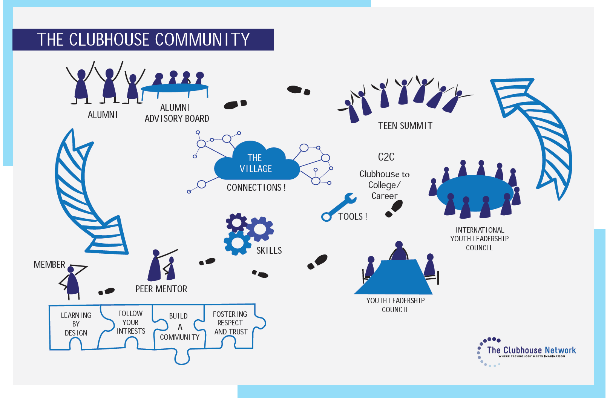
Youth Leadership Councils are central to building leadership skills and inclusive community engagement throughout a Clubhouse Member’s (The Clubhouse Network’s word for “mentee”) journey into adulthood. All Clubhouses are encouraged to support Members’ leadership development through our Clubhouse Continuum Model for Youth Leadership Development. Throughout each facet of the Continuum Model, additional leadership and skill-building opportunities are introduced, from early Clubhouse Membership to life as an adult and lifelong Clubhouse alum. This intentional focus on leadership throughout a Member’s personal and professional endeavors supports more equitable leadership representation in STEM/STEAM careers and other fields by including voices from those representing marginalized identities, in particular, at the table.
Our work launching Youth Leadership Councils revealed several key takeaways:
1) Empower youth to direct their projects – Youth Leadership Councils vary across the Network to reflect the unique interests represented by each group of youth. Some Councils focus on internal programming (the Clubhouse budget, field trips, guest speakers, etc.), while others concentrate on community projects (community service, policy making, etc.). At the ListoAmerica Clubhouse in Tustin,
CA, for example, youth formed American Youth for Justice. This group convened in the aftermath of George Floyd’s murder to use Clubhouse technology to design a logo, flyers, and banners to express their beliefs.
Youth should be empowered to decide the focus and structure of their own Youth Leadership Council. Staff and mentors can support this process by facilitating a brainstorming session, where youth identify key needs they wish to address. One approach is for staff to hang poster boards labeled “Organizational issues,” “Community issues,” and “World issues” around a room, and youth can jot down topics they’d like to tackle through the Council, thereby developing their own Council agenda.
2) Train mentors to take a backseat – Many adults are used to being the authoritative decision-maker, the person who has the final say in conversations with youth. Clubhouses found a need to train mentors out of this mindset. Instead, mentors should take a backseat as youth drive their own meetings and experiences.
This isn’t to say there’s no place for mentors in youth-centered programming; in fact, many Clubhouses reported that mentors offered vital structure and project management when Councils initially launched. Several IMPACTS Clubhouses used a scaffolded approach, where mentors initially helped with the administrative aspects of launching a Council, and then gradually transitioned ownership over to youth. Mentors were especially helpful at the beginning of a Council, when coordination involved tasks like reserving rooms and scheduling a time to meet. Mentors also collaborated with youth to set an agenda and facilitate the initial meetings. As time went on, youth took ownership over the meetings and began setting agendas and facilitating meetings autonomously.
3) Broaden the definition of “leadership” – Leadership is not a fixed trait, nor is it a single, well-defined quality. Many people have clear definitions of leadership based on what they’ve observed in the past – both in terms of physical characteristics and the approaches leaders take. Clubhouses have broadened the definition of leadership to acknowledge and value different leadership styles – whether that’s a collaborative approach, an approach based on listening, or one in which someone delegates well. All of these traits can be recognized and celebrated as aspects of leadership. Youth Leadership Councils have made a positive impact on Clubhouses around the world. They have also created opportunities for youth to become engaged in decision-making processes and gain lifelong skills. As Karla Camacho, a young person in Tustin, California said:
“Through the Clubhouse and other leadership projects, I’ve learned about myself that I’m capable of a lot more than I give myself credit for. I’ve gained a lot more self-confidence, and I’ve found a talent that I have for speaking.”
Karla Camacho, ListoAmerica Clubhouse
Through IMPACTS 2.0, The Clubhouse Network and subgrantee Clubhouses created a Youth Leadership Council Toolkit, which offers guidance on how to launch a Youth Leadership Council and provides template material, including a position description, orientation material, evaluation instrument, and more. The IMPACTS 2.0 team also collaborated with youth to create a video about youth voice at The Clubhouse Network.
You can access the Youth Leadership Council Toolkit here: https://theclubhousenetwork.org/programs/youth-leadership-council/
You can view the Youth Voice video here: https://www.youtube.com/watch?v=acRJp2hqF1Q&ab_channel=TheClubhouseNetwork
About The Clubhouse Network:
The Clubhouse Network is an international community of more than 100 Clubhouses located in 21 countries, providing youth with life-changing opportunities for over 25 years. Each Clubhouse provides a creative, safe, and free out-of-school learning environment where young people from underserved communities work with adult mentors to explore their own ideas, develop new skills, and build confidence in themselves through the use of technology. You can learn more at https://theclubhousenetwork.org/.
You can connect with The Clubhouse Network on the following platforms to receive additional resources and communications:
- https://twitter.com/theclubhousenet
- https://www.facebook.com/theclubhousenetwork
- https://instagram.com/clubhousenetwork
- https://www.youtube.com/c/TheClubhouseNetwork
- https://www.linkedin.com/company/clubhouse-network/
Jennifer Bourgoin biography:
Jennifer Bourgoin is the Mentor Program Manager at The Clubhouse Network. In this role, she manages the implementation of IMPACTS, an OJJDP-funded program designed to increase mentor participation and engagement. Jennifer develops training materials for Clubhouse staff and mentors, fosters a community of practice, and implements evaluation and assessment tools and techniques. Jennifer previously worked as a Program Manager at MENTOR, where she supported the development of research-informed resources for the mentoring field Jennifer is currently pursuing her M.Ed in Instructional Design at UMass Boston.
Christine Monska biography:
Christine Monska is the Youth Leadership Program Manager at The Clubhouse Network. She oversees youth leadership programs which include an International Youth Leadership Summit that uses participatory design thinking processes to create solutions to the most pressing global challenges, technical assistance to organizations creating Youth Leadership Councils, workshops on inclusive leadership, a growing alumni network supporting young professionals. Christine also serves as Co-chair of The Clubhouse Network’s Equity Team. Christine has over twelve years of experience in public policy, international relations, and leadership development with a strong focus on women and girls’ empowerment. Christine holds a M.S. in Global Affairs, International Law and Human Rights from New York University, a certificate in HBX Core from Harvard Business School, and B.A. in Government from Smith College.