Balancing Structure and Flexibility to Provide Successful Mentoring in Native Communities
Author’s Note: This material is based upon work supported by the Office of Juvenile Justice and Delinquency Prevention, Award Number 2015-JU-FX-0015. Any opinions, findings, conclusions, or recommendations expressed in this publication are those of the author(s) and do not necessarily reflect the view of the U.S. Department of Justice.
References
- Executive Office of the President. (2014). 2014 Native Youth Report. Retrieved March 16, 2016, from https://obamawhitehouse.archives.gov/sites/default/files/docs/20141129nativeyouthreport_final.pdf.
- Perkins, D. F. and Hartless, G. (2002). An Ecological risk-factor examination of suicide ideation and behavior of adolescents. Journal of Adolescent Research, 17(1).
- U.S. Census Bureau, U.S. Department of Commerce. Data from the 2008-2012 Amer. Community Survey 5-year estimates (Dec. 17, 2013).
You often hear statistics about Native youth, like 1 in 3 American Indian/Alaska Native youth lives in poverty (U.S. Census Bureau, 2013) and of all U.S. youth (ages 12 to 17), Native youth have the highest lifetime prevalence of major depressive episodes (Executive Office of the President, 2014). Unfortunately these statistics, and many more, illustrate the challenging realities of growing up Native. Often geographically isolated, it can be very difficult for youth and families to have access to the opportunities for skill, competency, and youth development in rural communities (Perkins, 2002).
“National 4-H Council (Council) has been serving rural and Native youth for more than 100 years. In 2010 we partnered with the Department of Justice, Office of Juvenile Justice and Delinquency Prevention, and our local 4-H partners and began working with Native youth through a specific tribal mentoring program that has now become the norm for many of these communities. When our program began in 2010, we decided to introduce Native youth to the 4-H National Mentoring Program through the 4-H Youth and Families with Promise Program (4-H YFP). 4-H YFP targets youth who have below-average school performance, poor social skills and/or weak family bonds and provides them with three key elements: one-to-one mentoring to help build academic and social skills; 4-H activities including leadership opportunities, community service, and group projects; and Family Nights Out, which are group activities designed to foster family bonds through experiential learning activities. Council currently serves 25 Native communities in 11 states reaching over 1,000 Native youth a year.
Through the 4-H YFP program, Native youth develop a sense of community that shows respect and pride to heritage and allows youth to share culture with others. Family relationships are strengthened by positive interactions, improving skills to reduce violence, and increasing family communication. 4-H YFP also creates a sense of community with functional relationships, encouraging youth to acknowledge problems within their own community and work to resolve them, and allowing access to positive networks that youth can rely on. Finally, 4-H YFP assists in addressing high poverty and substance abuse by giving youth access to resources, youth in the same situations (issues of relativity), and promotion of pro-social behavior.
The success stories that have come out of these communities have been extraordinary, from community service to restoration of cultural heritage to creating a safe place with caring, attentive adult mentors.
- On the Standing Rock Sioux Reservation the 4-H group has started their own business with the help of their leader and mentors called Sioux Imagine where they create goods including embroidered clothing, beaded jewelry and pottery to sell at state fairs and on the reservation. According to their leader this business has provided them all with a sense of hope and opportunity.
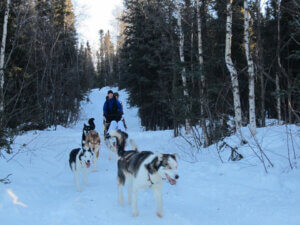
- In Fairbanks, Alaska, mentees participate in training service dogs through their collaboration with The Other Paw Assistance Dogs organization. Mentees and their mentors were even invited to visit the Sirius Sled Dog Tours (operated by one of the program’s mentors). This operating dog sled tour company showed mentees how to help harness the dogs and hook them up, and how they can make a business out of owning sled dogs. All mentees had a chance to both ride in a sled basket and also stand up on the sled runners and practice steering. They also learned about dog care and how to keep a dog yard clean, and had an opportunity to see a new litter of pups.
- In Franklin County, New York, mentors are taking a “whole person” approach to positively impacting mentees. To combat childhood obesity among Native youth, mentors receive the Choose Health training when they first enroll, an initiative of the Cornell Cooperative Extension 4-H Youth Development Program. Mentors foster in youth an appreciation of the benefits of exercise, educate them on nutritious food and beverage selections, and help them discover how strong the mind-body relationship is. To further the impact, they strive to also educate the families of the mentees on the importance of healthy eating habits and exercise.
The 4-H National Mentoring Program in Native communities has amplified and expanded the reach of 4-H while providing long lasting and impactful results for Native youth. What has made this program so effective is the blending of an effective program structure (the 4-H YFP program) with the understanding that each Native community is distinct and unique, with its own local strengths and traditions. We have found that mentoring is a very consistent, but organic, aspect of Native culture, and rather than prescribing a specific format for how mentoring “should” look, 4-H YFP in Native communities is effective because it works for the community and is flexible, relying on established relationships and traditions within each Native community. Similarly, the 4-H activities and family engagement components of the program are culturally compatible and build on the strengths of the community, as the Fairbanks example illustrates.
For mentoring programs seeking to serve Native youth effectively, knowing the needs of the community and incorporating the basic structure for an effective program, while remaining adaptable, are key elements of successful programming. 4-H is committed to continuing to nurture the sacred trust developed between local 4-H, tribal councils and families of mentees in tribal communities