New OJJDP Research-in-Brief on Mentee Risk Status and Mentoring Program Practices as Predictors of Match Outcomes
Source
Kupersmidt, J.B., Stump, K.N., Stelter, R.L., and Rhodes, J.E. 2017. “Mentee risk status and mentor training as predictors of youth outcomes.” Final report for the Office of Juvenile Justice and Delinquency Prevention, grant number 2012-JU-FX-0009. NCJ 251380, https://www.ncjrs.gov/pdffiles1/ojjdp/grants/251380.pdf
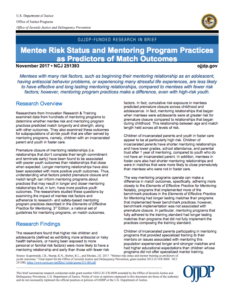
A new OJJDP-funded Research-in-Brief, released this November, explores how risk factors experienced by mentees – as well as mentoring program practices – can predict the length and strength of mentoring relationships, along with other outcomes. The researchers found that youth exhibiting more antisocial behaviors or other risky health behaviors, and those that have been exposed to more personal or family risk factors, were more likely to experience a match closure, particularly if the match began during adolescence versus early childhood. The study also looked at the practices of mentoring programs based on the standards outlined in the Elements of Effective Practice for MentoringTM and how these related to youth outcomes. In particular, the study found that youth with an incarcerated parent and youth in foster care who participated in a program that offered specialized training for their mentors around the specific issues they faced experienced longer and stronger mentoring relationships than those in mentoring programs that did not offer these specialized trainings, among other outcomes.
Learn more about this research, and its implications for policy and practice, by accessing the full bulletin here.